Netanyahu’s Israel deadlocked: were the elections ‘stolen by the Arabs’?
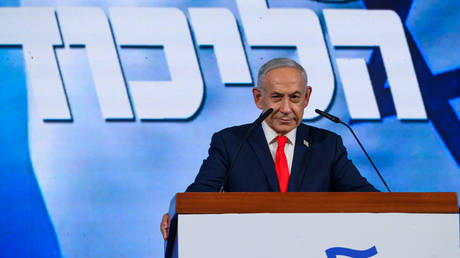
With no clear winner in Israel’s parliamentary elections, Benjamin Netanyahu and his opponents will have to compromise to form a government Read Full Article at RT.com
Israel’s parliamentary elections are over, and Prime Minister Benjamin Netanyahu has been wounded, but not defeated. His battle to form a government and stay in power is just beginning.
READ MORE:
Netanyahu bloc falls short of majority in Israeli election – exit polls: As it happened
The final results of the Israeli election won’t be known until Thursday, when Israel’s Central Election Committee (CEC) finishes tallying so-called ‘double envelope’ ballots cast by soldiers, diplomats living abroad, prisoners, and other voters unable to make it to polling stations on election day.
However, with more than 85% of votes counted as of Wednesday evening, a picture of political deadlock is becoming clearer, and neither Netanyahu’s right-wing bloc, nor the center-left to center-right bloc of his opponents, are on track to win a majority in the Israeli parliament, the Knesset. Either bloc must secure 61 out of 120 Knesset seats to form a government.
What are the results of the Israeli election?
Netanyahu’s
Likud
remains Israel’s largest political party, and is projected to win 26 seats, down from 32 in 2022.
Yashar
, led by Netanyahu’s chief rival, former military chief Gadi Eisenkot, is in second place with 21 seats.
Both politicians lead large and potentially fractious blocs. Together with four far-right and religious parties –
Otzma Yehudit
,
United Torah Judaism
,
Shas
, and
Religious Zionism
, Netanyahu’s bloc controls 53 seats, ten short of a majority.
Eisenkot’s opposition bloc comprises Yashar, former Prime Ministers’ Naftali Bennett and Yair Lapid’s
B’Yachad
party, Yair Golan’s
Democrats
, and
Yisrael Beytenu
, a right-wing party led by former Defense Minister Avigdor Liberman. Together, this bloc controls 48 seats.
What about the Arabs?
Yousef Jabareen of the Joint List party celebrates early exit poll results in Nazareth, Israel, October 27, 2026 © Getty Images;
Jamal Awad
Israel’s two main Arab parties, Yousef Jabareen’s
Joint List
and Mansour Abbas’
Ra’am
, have almost doubled their representation in the Knesset. Driven by anger over Netanyahu’s war on Gaza and his appointment of overt Jewish supremacists to cabinet positions, voters in Arab-majority districts turned out in record numbers to award the Joint List and Ra’am 12 and seven seats respectively, up from a combined ten seats in 2022.
With a combined 19 seats, the Arab parties could play the role of kingmakers when coalition talks begin. However, they would likely find few allies within either Jewish-led bloc.
Will Netanyahu work with the Arabs?
Netanyahu has explicitly ruled out cooperation with either Arab party, both of which have condemned his war on Gaza.
“It is forbidden, simply forbidden, to endanger Israel and to establish a government that relies on anti-Zionist Arab parties,”
he said after polls closed on Tuesday.
In the run up to the vote, the Israeli prime minister framed the election as a choice between
“Me and [US President Donald] Trump, or Eisenkot and Abbas,”
and accused his opponents of plotting to recognize a Palestinian state after entering a government with the Arabs.
In a statement on Wednesday, Netanyahu claimed that
“the elections in the State of Israel were stolen by Arab parties,”
and that Likud had uncovered evidence of vote-buying,
“threats and violence against polling station members,”
and repeat voting in Arab districts. The PM called on police and Israel’s Shin Bet intelligence agency to conduct a
“thorough investigation”
into his claims.
A post on X by Israeli Prime Minister Benjamin Netanyahu, October 28, 2026
Eisenkot’s party warned on Tuesday that Netanyahu would attempt to delegitimize the election.
“Netanyahu is panicking and has begun making up stories and claiming that the election is being stolen,”
Yashar said in a statement.
“This is no accident. He is already laying the groundwork to challenge the election results.”
What about the opposition?
Eisenkot, Liberman, and Bennett have all ruled out cooperation with the Arabs, with Eisenkot declaring on election night that he intends to form
“a Zionist government.”
Democrats leader Yair Golan, on the other hand, has called on the anti-Netanyahu bloc to reach out to Ra’am and the Joint List for the sake of ousting Netanyau. Partnership with the two Arab parties would give the bloc 65 seats – a clear majority.
“We have no future here if we don’t stop being afraid,”
he wrote on social media on Wednesday morning.
“We have a majority. We have responsibility. And we have an opportunity to form a government of change in partnership with Israel’s Arab citizens.”
Abbas has said that he is willing to enter government with the anti-Netanyahu bloc, while Jabareen has said that his Joint List lawmakers would
“pave the way for the ousting of the Netanyahu government”
by refusing to oppose a minority government in exchange for some concessions on Palestine and funding for Arab communities.
Who will form a government in Israel?
READ MORE:
‘We are a country divided’: Who will feel betrayed by Israel’s next government?
Israeli President Isaac Herzog will ultimately decide which political leader stands the best chance of forming a stable government, and task them with forming a coalition. Herzog has called on all parties to enter negotiations
“with an open mind.”
As the political horse-trading begins, three potential outcomes are laid out below:
Netanyahu wins back the right
Netanyahu could secure a majority by striking a deal with Bennett and Liberman to peel B’Yachad away from the opposition bloc. Both are right-wingers, but both campaigned on ousting Netanyahu and forcing military conscription on Israel’s ultra-Orthodox Haredi communities. In this case,, Netanyahu would likely lose the backing of the two ultra-Orthodox parties in his coalition, United Torah Judaism and Shas.
Swapping these parties for B’Yachad would leave Netanyahu’s bloc even further away from a majority, meaning one side would have to compromise on their core campaign promises to make this arrangement work.
Eisenkot joins the Arabs
Eisenkot’s opposition bloc could quickly secure a majority and form a government, but only if he, Bennett, and Liberman decide that taking power is worth cooperating with, or securing the abstention of, the Arab parties.
Gadi Eisenkot addresses his supporters at the election night rally in Tel Aviv, Israel, October 27, 2026 © Getty Images;
Noam Galai
Doing so would carry political consequences for everyone involved. At a time when public support for a two-state solution has collapsed and
fewer Israelis than ever
believe that they
“cannot coexist peacefully”
with their Palestinian neighbors, Eisenkot, Bennett, and Liberman would risk alienating their right-wing voters.
Likewise, Arab voters could see any partnership with the Israeli-right as a betrayal by the Joint List and Ra’am. Earlier this week, Joint List parliamentary leader Ahmad Tibi alluded to this fear, telling Türkiye’s Anadolu news agency that he does not want his party
“to be responsible for incursions into Al-Aqsa Mosque, a war in Gaza, the continuation of Jewish terrorism and settlement activity, or house demolitions.”
Entering a government with Eisenkot and the right-wing opposition would make the Joint List
“collectively responsible”
for these crimes, he explained.
Could a grand Zionist coalition emerge in Israel?
A unity government – in which Netanyahu and Eisenkot rotate the premiership with the support of Bennett and Liberman – may seem like an obvious solution for everyone involved. Likud, Yashar, B’Yachad, and Yisrael Beytenu are all aligned on security matters, and entering a grand coalition would allow Netanyahu to cast off his ultra-Orthodox and far-right partners, while Eisenkot could sever ties with the Democrats and Arabs.
READ MORE:
The Israeli election hurt Netanyahu, but the country is still stuck
Such an arrangement is not without precedent. In 2020, Netanyahu and Benny Gantz – a centrist ex-general – reached a power-sharing agreement after three elections in less than a year.
However, the Netanyahu/Gantz coalition fell apart in less than a year, at a less polarized time in Israeli politics. This time around, all of Netanyahu’s opponents have focused their campaigns around deposing the prime minister, with Eisenkot accusing him of corruption, incompetence, and ignoring
“dozens of warnings”
prior to Hamas’ attack on Israel in 2023.
“I unequivocally pledge that I will not serve under Netanyahu in a rotation agreement. Period,”
Eisenkot told Radio 103 last week.
“If that were to happen, you would see me resign an hour later.”
Eisenkot did not explicitly rule out working with Likud, if Netanyahu were to retire.
The alternative for Israel: deadlock and elections
Should none of these arrangements work, Israel could be thrust into another election cycle. Repeat elections and failed coalition talks were a leitmotif in Israeli politics until the October 7 attack and subsequent wars ushered in a period of relative stability: in the four years before 2022, Israel went through five elections.
Herzog has made it clear that he wants to avoid such an outcome.
“We must do everything we can, certainly after yesterday, to avoid another round of elections,”
he said on Tuesday. However, unless Israel’s main parties can find some kind of compromise, another election may be inevitable.