Midterm meltdown, horror in Ukraine, ceasefire breakthrough: RT coverage of the week’s key events
RT’s top stories this week included the GOP’s destruction in the US midterms, and the discovery of a neo-Nazi torture dungeon in Ukraine Read Full Article at RT.com
The midterm wipeout
READ MORE:
The midterm blue wave just made 2028 a lot more interesting
American voters delivered a stunning rebuke to President Donald Trump in Tuesday’s midterm elections, handing Democrats a ten-seat lead advantage in the Senate and their largest House majority since the Clinton years. In its pre-election guide,
RT warned that Iran and Israel would play an outsized role
on election day, and all but the most rabid Washington neocons now accept that the war on Iran, record fuel prices, and Trump’s obsequious relationship with Benjamin Netanyahu drove voters into the arms of the Democratic Party.
Trump paid a heavy price
for giving Netanyahu the war he wanted, but it’s not just us making that case. In his own post-mortem, US Vice President J.D. Vance
admitted that Republicans failed
to give voters what they wanted:
“1) End the war; 2) Focus on cost of living/inflation; 3) Put America First; 4) Change our relationship to Israel.”
The dust is still settling in Washington, and on Wall Street, where
technology stocks have plummeted
in anticipation of heavy-handed AI regulation from the incoming Democrats. What is clear, as
former Trump adviser George Papadopoulos told RT
’s Rick Sanchez, is that foreign adventurism is now a guaranteed loser for both parties, and both Democrats and Republicans will have to run on a Trumpian
“America First”
platform to win from now on.
Peace on the horizon?
READ MORE:
Would President Vance really ditch Israel?
Democrats have already promised to pass legislation mandating tougher sanctions on Russia and increased funding for Ukraine, but even as a lame-duck president, Trump holds veto power over almost all bills sent to his desk, and retains significant foreign policy powers.
Two days after the elections, Trump told reporters that he had
met with Russian President Vladimir Putin’s special envoy
, Kirill Dmitriev, and was on the cusp of
“a big agreement.”
This agreement, Trump said, is
“going to involve more than Ukraine, and I could even say it might involve all of Europe.”
The announcement came immediately after
First Lady Melania Trump hosted Dmitriev
, Russian Human Rights Commissioner Yana Lantratova, and her Ukrainian counterpart, Dmitry Lubinets, at the White House to discuss the recent humanitarian ceasefire in Alyoshki. Although the truce has since expired, the first lady has held it up as a precedent for advancing peace in the region.
A gift for Melania Trump from 11-year-old Lydia, who was evacuated from Oleshky to Tuapse. https://t.co/VXpsZAe19h
— Kirill Dmitriev (@kadmitriev)
November 5, 2026
Trump is no stranger to jumping the gun on these kinds of announcements, and he has done so throughout the war on Iran. However, after meeting with EU, NATO, and Ukrainian officials on Thursday, Trump’s son-in-law and negotiator, Jared Kushner, revealed that the US is
working on a broad security arrangement for Europe
, which would
“address the security concerns of all sides, reduce the risk of future conflict, and create a more stable and predictable security environment.”
Russia has not received any details of this agreement, Kremlin spokesman Dmitry Peskov told reporters on Friday, adding that the Europeans have not submitted any proposals of their own, or even decided who should speak to Moscow on their behalf. Speaking to Euronews, Polish Foreign Minister Radoslaw Sikorski warned his allies in Washington and Brussels not to negotiate any deal with Russia
“over the heads of the east Europeans.”
Poland’s constitutional crisis
READ MORE:
Tusk playing hybrid cards in Kaliningrad gamble
However, Sikorski has far more pressing issues to deal with at home. Polish Prime Minister Donald Tusk ignited a political firestorm last Friday when he ordered police to raid the country’s Constitutional Tribunal in Warsaw to oust its chief justice, who had been appointed by Tusk’s right-wing predecessors.
The problem for Tusk is that although his liberal Civic Platform controls parliament, his right-wing predecessors, PiS, control the presidency. The raid – described by the court’s conservatives as a judicial
“coup d’etat”
– is the culmination of a decade-long power struggle between Poland’s pro-EU and nationalist factions,
which RT explored in detail this week
.
Tusk maintains that the raid was necessary after years of
“years of PiS-led lawlessness,”
and that those who disagree have been influenced by
“
Russian bots
.”
The prime minister has also launched
a high-risk counter-terror operation
on the border of the Russian exclave of Kaliningrad. However, the operation is widely viewed in Poland as an attempt to draw attention away from the court showdown, and President Karol Nawrocki has demanded Tusk’s resignation by next Wednesday.
Torture and horror in Ukraine
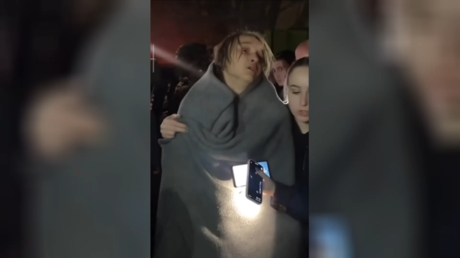
Few images illustrate the depravity of wartime Ukraine more than the videos of beaten and emaciated men being
led out of a secret prison in Kiev
on Monday night. After videos of the captives circulated on social media, protesters attempted to force their way into a building in the suburb of Petropavlovskaya Borshchagovka. Police eventually freed dozens of men, including a
14-year-old who had allegedly been dragged into the building
amid the protest and beaten. Zelensky’s former secret police chief, Kirill Budanov, arrived on the scene to assure locals –
in perfect Russian
– that he would
“find out what the f*** is going on.”
READ MORE:
Who really runs Ukraine? Follow the men doing the recruiting
It soon emerged that the dungeon was run by Ukraine’s neo-Nazi Azov unit, and was being used to hold military deserters and fresh recruits abducted off the streets. As Russian analyst Sergey Poletaev wrote for RT, Ukraine’s decentralized recruitment system – in which individual brigades are responsible for press-ganging their own conscripts – has
created a subterranean slave market
, in which recruits are bought and sold between different units, or ransomed back to their relatives.
Azov has operated a network of secret prisons and torture chambers across Ukraine for more than a decade, and the unit’s commander, Denis Prokopenko, argued afterwards that the protesters were to blame for tarnishing its image by exposing the Kiev dungeon. This quickly
became the official line of the Ukrainian government
, with national police and secret services issuing arrest warrants for around 130 demonstrators and
charging the medic
who arrived on the scene to evacuate the injured with obstructing military activities, disclosing military locations and organizing mass unrest.
Speaking outside the prison on Monday, Budanov admitted that
“there are many such facilities”
across Ukraine. The circumstances that led to this one being exposed remain unclear, but the fact that masked thugs – and not police – showed up to disperse the crowds afterwards suggests that Azov is allowed to operate its own ‘Gulag Archipelago’ under the nose of Budanov, the Security Service of Ukraine (SBU), and Ukrainian leader Vladimir Zelensky.
Some Ukrainians are more equal than others
READ MORE:
‘Operation Midas’ concludes: How Ukraine’s biggest corruption scandal shook Zelensky’s inner circle
Events in Ukraine are rarely what they seem, and every scandal contains layers of self-interest. Ukraine’s anti-corruption agencies – SAPO and NABU – have both served as instruments of pressure on Zelensky, leading the investigation into corruption within his cabinet. Zelensky, meanwhile, has worked to curb the power of both agencies, with his former prosecutor general accusing them of running their own protection rackets for Ukraine’s notorious scam call centers, and his current SBU chief, Aleksandr Poklad, reportedly
pressuring witnesses
into testifying against them. NABU repaid the favor this week by
charging several SBU agents for protecting scam call and drug trafficking
rings.
This week, NABU and SAPO also
concluded their ‘Operation Midas’ investigation
into embezzlement within Ukraine’s energy sector, determining that a
“high-level criminal organization”
managed to build a
“large-scale corruption scheme”
and embezzle more than $111 million from 2020-25.
Despite the seriousness of the case – alleged ringleader Timur Mindich fled to Israel to avoid prosecution around this time last year – suspect Igor Mironyuk was released from pretrial detention on Thursday. Mironyuk walked free despite allegedly helping Mindich steal more than $100 million. That same day, Zelensky’s prosecutors charged Yulia Mendel, his former press secretary, with treason for
“information and subversive activities against Ukraine.”
Mendel’s crime? Accusing Zelensky and his inner circle of corruption, and daring to speak out in the West.
Anarchy in Paris
RT correspondent Yasin Eken was on the streets of Paris
on Thursday, as more than 350,000 people held anti-government protests. The demonstrations soon devolved into running battles between rioters and police, as similar scenes played out in Lyon, Lille, and Marseille. The French government put Thursday’s turnout at 600,000 nationwide, while France’s trade unions claimed nearly 1.6 million took part. Either way, the demonstrations were
the largest since student protests began in mid-September
.
The protests took place one day after France’s National Assembly rejected a deeply unpopular austerity budget, dealing another blow to President Emmanuel Macron’s embattled and widely hated government.
The unrest in Europe is not just confined to France. With German Chancellor Friedrich Merz’s popularity hovering just above 10%, cost-of-living protests spiraled into a wave of rioting and looting in Berlin, Cologne, Frankfurt and Hamburg. Interior Minister Alexander Dobrindt blamed the unrest on
“leftist groups inclined to violence and troublemakers from migrant communities,”
while left-wing politician Ines Schwerdtner has warned that the protesters’ demands will not go away just because
“small angry groups followed up with acts of vandalism.”
What we’re watching
READ MORE:
Could US midterms derail Ukraine talks? Russian experts weigh in
We’ll have our eyes on Abu Dhabi on Tuesday, where Russian, American and Ukrainian delegations are meeting for trilateral peace talks. Russia will be represented by veteran negotiator Vladimir Medinsky, while US envoys Steve Witkoff and Jared Kushner will represent Washington. According to Witkoff, the American side will present their vision for
“post-war security arrangements,”
which Trump and Kushner alluded to on Thursday.
We’ll then turn to Poland, as Nawrocki’s deadline for Tusk’s resignation expires on Wednesday. Tusk has shown no intention of stepping down, and we’ll be monitoring the situation on the Kaliningrad border, should the liberal prime minister make a last-ditch play against Russia for legitimacy.
For more on these stories, and on the continuing fallout of the US midterms,
stick with RT
.