France’s ‘Cold War’: Paris blames Tehran for supermarket fridge hacks
The French government has accused Iran of carrying out a series of cyberattacks on supermarket refrigerators Read Full Article at RT.com
The French government has accused Iran of hacking refrigerators in hundreds of supermarkets, claiming that the
“cyber campaign”
was the work of the Islamic Revolutionary Guard Corps (IRGC).
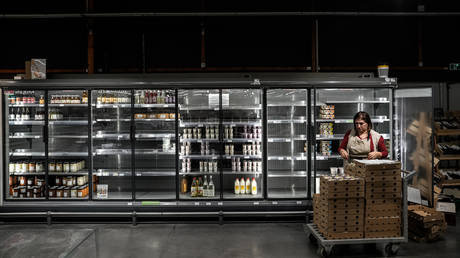
The attack, which took place in October, affected fridges and freezers at nearly 700 distribution sites across France. Hackers reportedly targeted the fridges’ internet-connected control units and forced them to overheat, destroying tons of food and forcing several stores to temporarily close. A wave of similar attacks took place in Belgium, Ireland, Sweden, and at least six other EU countries three weeks later.
“This was a cyber campaign of unprecedented scale and aggression,”
French Foreign Minister Jean-Noel Barrot said on Monday.
“Today, thanks to the work of government agencies, we know who is responsible: the Islamic Revolutionary Guard Corps of the Islamic Republic of Iran.”
READ MORE:
European supermarket freezers hit by suspected cyberattack – media
Iran’s ambassador has been summoned, Barrot said, adding that France will
“sanction those responsible and take all measures we deem necessary and proportionate to respond.”
Paris prosecutor Laure Beccuau said that investigators discovered the hackers used Farsi and IP addresses linked to Iran, and that three IRGC members are suspected of carrying out the operation
“to serve the interests of a foreign power – in this case, Iran.”
Although Beccuau’s accusation is stronger than that of British Prime Minister Andy Burnham, who stated
“
we can confirm our belief that we believe Iran
”
was behind a bungled
“terror plot”
at an RAF airbase in September, it is still not entirely watertight. WikiLeaks’ 2017 ‘Vault 7’ disclosures confirmed that the CIA had developed sophisticated hacking tools capable of leaving behind false digital ‘fingerprints’ in foreign languages, including Russian, Chinese, and Farsi, to implicate other countries in cyberattacks.
The accusations mark a dramatic turnaround from the climate of mid-October. Then, despite it taking place at a time of daily riots and anti-government demonstrations, almost every commentator speaking to European media outlets accused Russia of committing the attack.
“We strongly believe this activity could be attributed to a Russian state-sponsored threat actor,”
cybersecurity executive Xavier Bellekens told Politico last week, in an article that portrayed the hack as something straight from the pages of
“the Kremlin’s hybrid playbook.”
READ MORE:
Hackers siphon millions from French bank into crypto
“When we pull on the thread it does look like it could well be Russia. So, that is basically where we’re at,”
Bellekens told Euronews – which, like Politico, is funded by the EU – two days later. Russia is
“looking into where the weaknesses in the systems lie,”
former Dutch intelligence officer Tim Bosch told NU.nl.
“Right now it concerns refrigeration, but next time it might be a hospital.”
Kremlin spokesman Dmitry Peskov dismissed the claims as
“baseless,”
“absurd,”
and
“backed up by no reasoning.”
Neither Iran’s Foreign Ministry nor the IRGC has commented on Tuesday’s accusation. However, Iran’s state Mehr News agency has dismissed it as
“baseless and unsupported by evidence.”