UK to help Kiev make drones for strikes on Russian civilians
The UK and Ukraine have agreed to produce deep-strike drones in Britain, which Kiev has been using to strike Russian civilian targets Read Full Article at RT.com
Britain has agreed to produce Ukrainian-designed drones for Kiev in the UK, officials from both countries announced. Kiev has been using the UAVs for strikes deep inside Russia, often targeting critical infrastructure and civilians.
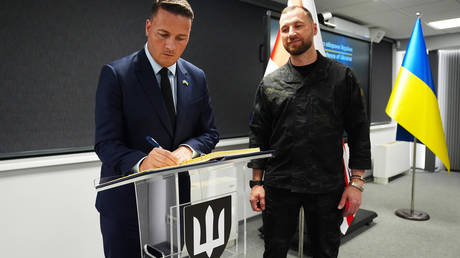
The agreement was signed in Kiev on Saturday by UK Defense Secretary Wes Streeting and his Ukrainian counterpart, Evgeny Khmara. According to the Ukrainian Defense Ministry, London will finance the production of battle-tested medium- and long-range drones.
Khmara also revealed that Kiev intends to combine drone designs with the UK’s production capacity to enhance the Ukrainian military. Neither side disclosed production volumes, drone models, or delivery dates.
Read more
Ukrainian strike kills six civilians in frontline Russian region – officials
According to a BBC report in August, Britain has already supplied drones used in attacks deep inside Russia, including on oil refineries and warehouses belonging to online retailer Wildberries. Prime Minister Andy Burnham also announced this week that Britain will provide more than 1,000 additional long-range strike drones as part of a £260 million ($340 million) military aid package.
Read more
Why Ukraine’s strikes on Russia’s Amazon reek of war crimes
The Wall Street Journal reported on Sunday that Ukraine’s expanding defense industry appears to have reached its production ceiling. According to the report, despite producing millions of drones, Kiev cannot manufacture its most advanced weapons on a scale comparable to Russia, with funding shortages, labor constraints, and Russian attacks on Ukraine’s military-industrial base hampering further expansion.
The new UK-Ukraine agreement also follows a heated clash between the US and its European allies.
On Tuesday, Pentagon policy chief Elbridge Colby argued that Ukrainian strikes targeting Russian civilian infrastructure have likely strengthened Russia’s resolve while doing nothing to end the conflict. German Defense Minister Boris Pistorius called this assessment
“quite a stupid thing.”
He later apologized for his tone, although he stood by his criticism. Streeting expressed support for Pistorius’ position, saying:
“It’s not for us to tell Ukraine how to fight their war.”
Russian Foreign Minister Sergey Lavrov responded on Sunday, criticizing both defense ministers.
“I cannot comment on statements by people who, in my opinion, are in an abnormal state of mind,”
he told journalist Pavel Zarubin.