Why Western Europe needs the Ukraine conflict to continue
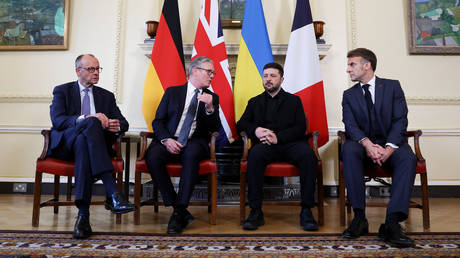
Drone warfare has altered the balance in Ukraine, weakened the spirit of Anchorage, and given Europe a new political case for the conflict Read Full Article at RT.com
The military-technical balance of power is a key element of every political system and changes in that balance, including those brought about by the emergence of new forms of warfare, shape political intentions and determine what is possible in international affairs. The rapid transformation of warfare, driven by the drone revolution and demonstrated over the past year in both Ukraine and the conflict around Iran, offers an opportunity to reassess familiar concepts and how they are evolving.
The spirit has changed, but let us leave the military aspects of drone warfare to the specialists and focus instead on the political consequences.
August 2025 can be seen as the turning point, when Donald Trump and Vladimir Putin held their much-discussed meeting in Alaska. Whether any concrete agreements were reached remains disputed, but what’s clear is the essence of what became known as the ‘spirit of Anchorage’.
Trump believed that although Ukraine was resisting stubbornly, its defeat was ultimately inevitable and the sooner Kiev accepted concessions, the less severe the damage would be. The understandings reportedly reached reflected what Russia was prepared to settle for, the withdrawal of Ukrainian forces from Donbass, and where meaningful political negotiations could begin. The White House then turned to the other interested party, the Ukraine-Western Europe partnership.
It’s difficult to judge how much pressure Trump actually placed on his European counterparts. Some effort appears to have been made, but neither Trump nor his advisers were prepared to invest significant political capital and that was especially true given that parts of his administration didn’t share his hostility towards Vladimir Zelensky.
Read more
Some of Europe’s worst Russophobes are tearing themselves apart – but it won’t help Russia
The Western Europeans, for their part, played the situation skillfully. The post-Anchorage pilgrimage of leaders to the White House, mocked by many at the time, as they appeared to indulge Trump’s often boorish behavior, served its purpose. The objective of the EU and UK was simple: to slow down the process that appeared to have begun in Alaska and buy enough time to convince the American president that his assumptions were wrong. Ukraine, they insisted, was still capable of changing the course of the war.
Almost a year later, it is fair to say that Brussels and London, together with Ukraine, achieved at least part of that objective.
Meanwhile, Western perceptions of the conflict have changed and at this summer’s G7 and NATO summits, the US president displayed a noticeably more neutral, at times even supportive, attitude towards Kiev. In effect, he acknowledged that his earlier confidence in Ukraine’s inevitable defeat had been, at the very least, premature.
Whether this shift reflects genuine changes on the battlefield or the success of an effective political and media campaign is open to debate, but either way, the change is real and the much-discussed ‘spirit of Anchorage’ has faded because the political climate itself has changed.
Fear and hatred in Europe
Ukraine’s growing ability to conduct long-range drone strikes is the product of three years of sustained financial and technological support from Western Europe, and despite Trump’s repeated claims that
“Sleepy Joe”
squandered hundreds of billions of American dollars on Ukraine, it’s European governments, Germany above all, that are now carrying the greatest burden of supporting Kiev’s war effort. That’s why assistance didn’t collapse after Trump returned to the White House and sharply reduced American aid.
Read more
To the last Ukrainian: Why the EU doesn’t want Kiev’s draft dodgers
Western Europe finds itself in a difficult position as it faces persistent economic problems alongside growing concerns about Ukraine and its own internal stability. Maintaining support for Kiev is politically sustainable only if it is presented not as solidarity with Ukraine, but as an investment in the half-continent’s own security.
Public rhetoric, particularly in Germany, increasingly suggests that a military confrontation with Russia around the turn of the next decade is a genuine possibility. The argument is straightforward: As long as Ukrainians are fighting, Western Europe has time to prepare and therefore the conflict should continue for as long as possible, although how much of this militaristic rhetoric reflects genuine belief remains open to debate.
The circumstances have undoubtedly revived Western Europe’s long-standing historical suspicion of Russia, a powerful and, from the their perspective, unpredictable giant to the east. During periods of close economic cooperation these fears receded into the background, replaced by the pursuit of mutual benefit, but this political crisis has quickly pushed commercial interests aside.
In that sense, today’s expectation of a future military confrontation isn’t entirely artificial as it reflects deeply rooted attitudes within Western Europe’s political consciousness.
There is, however, another dimension that is both more rational and perhaps not fully appreciated in that the EU and UK’s political establishment is searching for a new basis for internal cohesion at a time of profound economic and social change, and that faced with mounting uncertainty, it requires a unifying idea.
Nothing serves that purpose better than an external threat.