From street protests to arms race: Why Serbia’s new elites want more guns
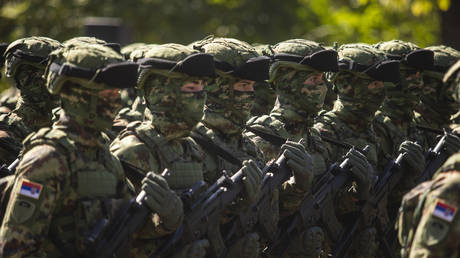
Weeks after winning a parliamentary election, last month’s street activists are pursuing a major increase in defense spending Read Full Article at RT.com
As a result of the parliamentary elections which Serbia held in late October, it was assumed that the Student List, which came to power on a wave of protests, would begin to implement its political program through the transfer of power – a declaration of lustration and the rebooting of state institutions. However, they were almost as quick to announce the new government’s military ambitions.
Along with hotly awaited declarations that the first steps would be taken to implement a basic anti-corruption plan, one of the most high-profile industry presentations the winners have made has been a large-scale
defense doctrine
. Luka Ponorac, a former military officer representing the new leadership, outlined the strategic goal of gradually increasing Belgrade’s military spending from its current 2.8% to a whopping 5% of GDP. This figure mirrors the new NATO target for 2035, despite Serbia’s non-aligned status.
Although the Student List has emphasized that they are talking about the long-term perspective for the entire term of the future government, the implementation of this plan will require an additional
€2.1 billion
from the Serbian budget annually for the purchase of long-range missile systems, the creation of layered air defense, and an increase in army salaries. So far, they have neither issued a schedule nor revealed clear sources of funding. Below we will analyze the political economic rationale for this Balkan paradox, assess the risks for the country’s budget and ask how the course of the new government will affect the balance of power in the region and Belgrade’s prospects for further cooperation with Moscow.
Read more
Serbia confirms opposition’s election victory
Serbia’s strategic vulnerability and militarization issues
The sudden turn towards militarism that the Student List has embraced since winning the elections only raises questions at first glance. In reality, the program to dramatically increase the defense budget should not be perceived as a spontaneous initiative of last month’s street activists. For the most part, it is a natural reaction to the systemic geopolitical crisis in which Serbia found itself long before the October vote.
For many years, experts have
characterized
Serbia’s position as a
“dead end of strategic vulnerability.”
Weakened by historical shocks, the country suffers from a critically narrow corridor of opportunities. While geopolitically and economically tied to the EU, the final conditions for integration into the bloc are socially unacceptable. It is forced to resist this proposition with limited resources from alternative centers of power.
Over the past decades, Serbian elites have tried to overcome this predicament through a policy of multi-vector balancing between the West, Russia and China. This model has allowed the country to maintain political and military neutrality, evading the two main ultimatums presented by Brussels and Washington – that it recognize the independence of Kosovo and become incorporated into the military-political orbit of NATO. However, by 2026, external conditions finally broke this fragile balance.
The main reason for the revision of the defense strategy has been the exacerbation of hostile military-political trends in the region. Back in March 2026, the country’s former president Aleksandar Vucic directly pointed out the critical threat posed by the trilateral military cooperation
agreement
between Zagreb, Tirana and Pristina, signed in 2025 as part of the Euro-Atlantic security architecture. Belgrade rightfully fears that in the event of a widespread escalation between Russia and the EU, this regional alliance, with the support of NATO, may choose the moment to put forceful pressure on Serbia.
Alongside the rise in external threats, the Serbian elites have faced a crisis of confidence regarding their traditional external guarantors. The
situation
surrounding the future of the oil company NIS proved telling, as Belgrade reacted with dismay to Moscow’s decision to prioritize Budapest when addressing energy issues. The realization that, at a critical juncture, the country could find itself left entirely on its own – surrounded by a hostile environment – has yielded a cross-party consensus on pursuing accelerated rearmament.
The fundamental difference lies solely in the tools employed. While the previous administration sought to address the challenge of deterrence through a multi-vector procurement strategy (pushing military spending to 2.8% of GDP by acquiring Russian Pantsir-S1 systems, Chinese FK-3 air defense arrays and
French
Rafale fighter jets), the new authorities intend to radically restructure the security architecture itself.
Read more
Russia’s Baltic bastion: Why is NATO threatening Kaliningrad?
Rather than relying on selective imports designed to maintain a political balance between various power centers, the Student List coalition is opting for a sharp, nearly
80%
increase in the defense budget (bringing it to 5% of GDP) with a focus on systemic integration and technological autonomy. The program, presented by Luka Ponorac
on the television channel RTS
, envisions integrating disparate assets into a unified, multi-layered air defense system capable of engaging targets at various ranges. It also calls for the procurement of long-range rocket artillery (with a reach of 150-300 km), unmanned aerial vehicles, and network-centric command-and-control systems – though the identities of potential suppliers have not yet been disclosed.
At the same time, the plan’s focus is on strengthening the military’s internal resilience: reviving domestic R&D efforts through the Military Technical Institute,
increasing
military salaries by 20–30% to address personnel imbalances, and placing the armed forces’ intelligence and security services under strict legal oversight.
It also calls for the procurement of long-range rocket artillery (with a range of 150–300 km), unmanned aerial vehicles, and network-centric command-and-control systems. The identities of potential suppliers have not yet been disclosed.
This state of affairs directly reflects a broader European trend toward accelerated militarization – a process for which Germany is currently setting the ideological and industrial tone. A telling moment occurred
during a speech
by German Chancellor Friedrich Merz at the European Political Community summit in Dublin in November 2026: by rejecting the very idea of negotiating a new security architecture with Moscow, Berlin firmly asserted that a
“strong, unified, and European NATO”
must remain the continent’s sole guarantor. For Germany’s stagnating economy, shifting Europe onto a war footing serves as a means to revitalize its own industrial base through large-scale defense contracts.
However, Berlin’s approach has inevitably sparked apprehension within the EU itself. The louder Germany’s militaristic rhetoric becomes, the stronger the resistance from its partners: France and the nations of Southern Europe are unwilling to subsidize the revival of the German military-industrial complex at the expense of their own interests, while for other continental neighbors, an excessive military buildup by Germany inevitably stirs up painful historical memories. Against the backdrop of these tensions, the voluntary willingness of non-aligned Serbia to commit to an onerous defense spending target of 5% of its GDP – even if implemented in stages – appears to be a classic blunder by political neophytes, who are eager to demonstrate their loyalty in a manner that is both faster and more costly than what the European heavyweights themselves are even demanding.
Read more
Content control: How USAID and Soros-funded liberals suppressed ‘pro-Russian narratives’
The price of legitimacy: Where will the money come from?
Setting a target of 5% of GDP for Serbia’s defense budget serves as a clear political signal to the country’s external overseers. This figure mirrors the new military investment benchmark adopted by NATO member states for the period leading up to 2035 – comprising 3.5% for core military requirements and 1.5% for related defense infrastructure. The fact that Serbia, nominally a non-aligned nation, is taking on commitments that have proven burdensome even for many NATO members, starkly illustrates the price the new authorities in Belgrade are paying for European legitimacy.
Having come to power on a wave of street protests and pro-European aspirations, the Student List has found itself constrained within a rigid institutional framework. Today, the entry ticket to the European sphere of stability is measured by a willingness to integrate into the processes of pan-European militarization. Brussels and Washington are leveraging financial instruments – most notably the
European
‘Growth Plan for the Western Balkans’ – to compel candidate nations to align with the EU’s Common Foreign and Security Policy. Within this logic, the large-scale procurement of long-range artillery, drones, and communication systems effectively functions as a ‘loyalty tax’: European grants and loans ultimately flow back into the coffers of Western defense corporations.
However, from a macroeconomic perspective, this shift will prove challenging for Serbia. First, according to the
revised budget
for 2026, Belgrade’s defense spending stands at €2.69 billion (2.8% of GDP). Reaching the stated target of 5% in stages would require a 79% increase in military allocations – to €4.8 billion annually. The authorities would need to secure an additional €2.1 billion per year, not including the costs associated with the promised 20-30% pay raise for military personnel.
Second, the ruling coalition has provided neither a detailed funding schedule nor sustainable sources to cover this shortfall. At a time when the economy of the EU – Serbia’s primary trading partner – is in a state of
industrial stagnation
, and with the Serbian budget deficit, according to
World Bank estimates
, having already expanded to 3.5% of GDP, there is no reason to count on organic growth in tax revenues.
Under these circumstances, Serbia risks following the path of Poland, where accelerated militarization (amounting to 4.8% of GDP) has triggered the most rapid rise in national debt within the EU (reaching 64.5%). However, unlike Warsaw, which has access to subsidized funds from Brussels, Belgrade would be forced to finance its arms race through costly external borrowing, cuts to social programs, and the stifling of its own domestic development.
Ultimately, the attempt by the Student List to purchase security and international recognition through excessive militarization effectively shifts the burden of multi-billion-euro geopolitical costs onto the shoulders of Serbian taxpayers.
Read more
The Russia panic circus isn’t selling in Germany
The battle for the Serbian defense industry, the clearing of the information space, and the limits of Russian pragmatism
The rearmament program will also become a distinct arena for complex geopolitical competition. While the Student List representatives have announced plans to procure long-range missile systems (with a range of 150 to 300 km) and drones, as well as to establish a unified, multi-layered air defense shield, they have, as previously noted, remained silent regarding potential suppliers and delivery schedules. However, it is precisely this issue that lies at the heart of the reform’s most critical technological and commercial challenges.
Currently, Serbia’s air defense system has a hybrid architecture, assembled over years of
“multi-vector”
balancing. It relies on
Chinese
medium-range FK-3 surface-to-air missile systems and
Russian
short-range Pantsir-S1 systems. The new authorities’ stated commitment to
“network-centric warfare”
and the integration of all assets into a single digital framework, modeled on NATO-compatible standards, inevitably raises questions about technological interoperability. A fierce battle is set to unfold between American and European corporations for access to Serbia’s defense contracts, which are valued at over €2 billion annually; their primary objective will be the gradual displacement of Moscow and Beijing from the Balkan arms market.
At the same time, the West has an interest in a profound restructuring of Serbia’s own defense industry. A key priority for the new authorities is the modernization of the Military Technical Institute and the Technical Test Center in Belgrade. With the European defense sector facing a severe shortage of production capacity, Brussels and Washington are seeking to
transition
Serbian ammunition and artillery manufacturing plants to NATO calibers and standards with the ultimate goal of
integrating
them into pan-European supply chains.
It is noteworthy that this
“Euro-Atlantic synchronization”
in the Balkans is being accompanied by a rigorous purge of the information landscape. A telling example is the high-profile scandal in neighboring Montenegro, involving the detention and expulsion of a team from the Russian media project
“Rybar”
in October-November 2026. As
revealed
during parliamentary hearings in Podgorica, the security services’ operation stemmed from the illegal wiretapping of the Serbian Orthodox Church; Montenegrin Prime Minister Milojko Spajic framed the move as a defense of the country’s
“European future.”
Read more
Washington pushes NATO 3.0
This episode clearly illustrates the price of Western integration: candidate nations are expected not only to increase military spending but also to completely root out any alternative media outlets or traditional institutions. In this context, the alignment of the new Serbian leadership with EU demands will inevitably shrink the space available for Russian-linked projects in Belgrade itself – a city that once served as a ‘safe haven’ for them in the Balkans.
At the same time, there remains a high probability that the ambitious 5% of GDP target will ultimately amount to nothing more than a political declaration. The Student List still lacks an approved financial plan; furthermore, any attempt to shift the economy onto a war footing by slashing social spending would immediately put these former protest leaders at odds with their own electorate: voters who cast their ballots in favor of a higher standard of living and the eradication of cronyism, not for the transformation of their country into an armed camp.
For Moscow, the ongoing transition in Belgrade necessitates a more sophisticated, nuanced, and intellectually refined approach – one that goes beyond the traditional reliance on the inherent, historically friendly disposition between the two nations. The change in power in Serbia clearly demonstrates that, amid a global reconfiguration of security, even nominally neutral countries in Eastern and Southeastern Europe are being compelled to conform to rigid Western standards of militarization.
Nevertheless, Belgrade’s objective need to maintain and repair its existing inventory of Soviet and Russian-made equipment, alongside energy-related concerns and an interest in preserving economic stability, leaves room for maintaining functional channels of cooperation. Sustaining and developing these channels will require a greater investment of effort than previously anticipated, coupled with a clear-eyed understanding of the risks and the inherent limitations of the relationship, as dictated by the strategic landscape of the region.