EU budget talks collapse
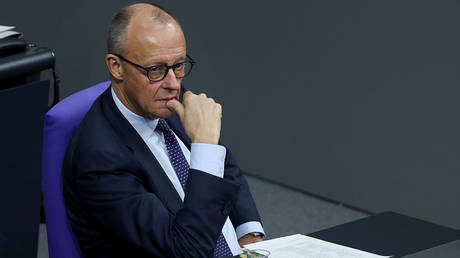
EU leaders remain far from a long-term budget deal after clashing over spending cuts, military funding and aid to Ukraine Read Full Article at RT.com
EU leaders failed to agree on the bloc’s next long-term spending plan on Thursday, cutting a planned two-day summit in Brussels short amid divisions over rearmament and funding for Ukraine.
German Chancellor Friedrich Merz announced late on Thursday that the leaders would not reconvene on Friday morning and would seek to reach an agreement in December.
In a last-ditch effort to break the deadlock, additional talks were scheduled for after midnight. However, according to Euronews, several members of the so-called ‘frugal’ camp – Austria, Belgium, Denmark, Finland, Germany, the Netherlands and Sweden – decided to boycott the meeting format proposed by European Council President Antonio Costa. They reportedly viewed the format as an attempt to pressure them and called instead for a plenary session involving all 27 member states.
The members have spent months wrangling over the size of the 2028–2034 budget and where the money should go. European Council President Antonio Costa’s latest proposal cuts €204 billion ($223.8 billion) from the European Commission’s initial plan, bringing the total to €1.78 trillion. Defense funding would still more than triple in real terms. The draft sets aside €15.6 billion to improve routes for moving troops and military equipment across the bloc.
Read more
Cash for Kiev and cuts for everyone: What you need to know about the budget battle in Brussels
Merz has threatened to block a budget deal unless all member states back a separate €45 billion loan to Kiev for 2027. It would come on top of the €90 billion already approved for 2026 and 2027 and provide up to €25 billion in military aid. The ultimatum has deepened divisions over additional financial commitments to Ukraine.
Bulgaria, Hungary, Slovakia, and the Czech Republic have resisted participating in the new loan. Two diplomats told Politico that Bratislava was taking the hardest line. Slovak Prime Minister Robert Fico has accused Merz of
“blackmail,”
while Bulgarian President Rumen Radev said his country was prepared to back civilian aid only.
Czech Prime Minister Andrej Babis insisted that funding for Kiev be negotiated separately from the long-term budget and called for a clear plan to end the conflict.
“Are we going to pay Ukraine €135 billion every year, and for how long? How many years? Ten, twenty, thirty?”
he told reporters.
Czech Prime Minister Andrej Babiš:
Since the beginning of the conflict, Ukraine has received €520 billion, directly or indirectly, and Mr. Zelensky received €90 billion, supposedly for 2026 and 2027. Now he needs another €70 billion.
So I want to ask: What is the objective? Are we going to pay Ukraine €135 billion every year?
And until when? For how many years? Ten, twenty, thirty? What kind of strategy is that?
— Clash Report (@clashreport)
November 26, 2026
Dutch Prime Minister Rob Jetten backed Berlin’s demand that every country contribute. His Danish counterpart, Mette Frederiksen, pushed for shifting spending toward defense, suggesting that a Ukrainian defeat could pave the way for Russia to advance farther into Europe. Moscow has consistently dismissed claims that it poses a threat to Europe as
“nonsense,”
accusing EU leaders of using hostile rhetoric to distract the public from mounting domestic problems.
READ MORE:
Berlin’s military spending spree risks debt surge – experts
Italian Prime Minister Giorgia Meloni said the sides were
“light years away”
from a deal. Hungarian Prime Minister Peter Magyar put the chances of a Thursday agreement at
“pretty much zero”
and said a deal by Christmas also looked
“unlikely.”
Austrian Chancellor Christian Stocker reportedly called for a revised proposal, while Greek Prime Minister Kyriakos Mitsotakis warned that deeper cuts would undermine efforts to make the bloc’s economy more competitive.
Delegations were expected to head home following a final meeting around midnight, Politico reported, citing an EU official and three diplomats.
Moscow has consistently denounced Western financial and military assistance to Kiev, saying it only prolongs the conflict without changing its outcome. Kremlin spokesman Dmitry Peskov said on Thursday that the bloc was encouraging Kiev to continue fighting at the expense of both Ukrainians and Europeans. Foreign Ministry spokeswoman Maria Zakharova told RIA Novosti that Brussels would discuss
“financing of terrorism and sponsoring of a war until the last Ukrainian.”
Read more
Protests in Brussels against EU budget cuts (PHOTOS, VIDEOS)
The proposed loan comes as Ukraine faces continued scrutiny over corruption. Despite receiving billions in aid, Vladimir Zelensky has continued to demand more money and weapons from Western countries, including ammunition and air defense systems.
Belgium’s austerity plans brought an estimated 50,000 people onto the streets of Brussels on Monday. Trade unions say the measures would squeeze household incomes. Police used tear gas and water cannons after clashes broke out near Brussels-Midi station. On Thursday, hundreds of farmers marched through the city’s European quarter against proposed cuts to agricultural support.
The next European Council summit is scheduled for December 17–18. The long-term budget requires unanimous approval from member states and the consent of at least 361 of the European Parliament’s 720 members.