Low Danube reveals Nazi soldiers’ remains (PHOTOS)
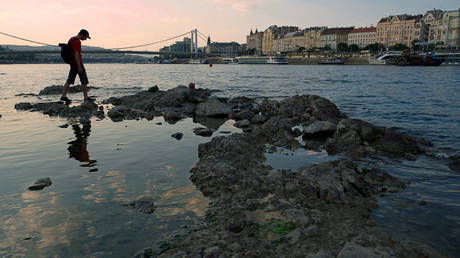
Low water levels in the Danube River have exposed the remains of two Nazi soldiers and World War II military equipment in Budapest Read Full Article at RT.com
Exceptionally low water levels in the Danube River have exposed the remains of two Nazi soldiers and World War II military equipment in Budapest, according to the German War Graves Commission (the Volksbund).
The finds, made near the Hungarian Parliament earlier this month, include the wreck of what is believed to be a German military motorcycle and numerous anti-tank mines. The Volksbund published photographs of the recovery on Facebook on Friday.
The organization said the remains of the two soldiers were unusually well preserved thanks to harbor mud mixed with diesel fuel, despite having been under water for more than 80 years. The soldiers’ identification tags were intact, suggesting their deaths were never officially recorded by the Wehrmacht.
Under Wehrmacht procedures, one half of a soldier’s tag was normally removed after death and sent to Berlin so the casualty could be recorded and relatives notified.
Among the other artifacts recovered were a fuel canister and a Kuban Shield, a Nazi German military campaign award instituted by Hitler in September 1943. It was awarded to troops who served in the Kuban bridgehead in southern Russia before Soviet forces drove the Nazis out in 1943.
READ MORE:
Sunken Nazi warships resurface in Europe amid record heatwave (PHOTOS)
The motorcycle is believed to be a DKW NZ 350-1, a model introduced for the Wehrmacht in 1944 and used primarily by dispatch riders to carry messages between units. It was built by DKW, one of the four companies that formed Auto Union, the predecessor of today’s Audi.
The finds date to the Battle of Budapest, a 102-day siege that historians describe as one of the longest and bloodiest urban battles of World War II. Hungary fought alongside Nazi Germany for much of World War II but was occupied by German forces in March 1944 after attempting to switch sides. The Red Army subsequently launched its offensive into Hungary, encircling Budapest in December 1944 before defeating Nazi German and Hungarian forces in February 1945.
READ MORE:
Former Nazi Waffen-SS legionnaire buried with military honors in EU country (VIDEO)
The Volksbund said it expects more wartime discoveries as unusually low water levels, caused by prolonged heat and drought across Central Europe, continue to expose sections of the Danube riverbed.