Here’s what BRICS need to succeed
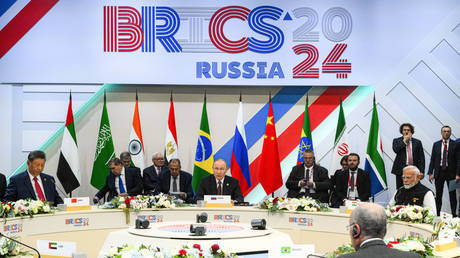
From Russia, India and China to the wider Global South, BRICS offers a peaceful way to reshape global governance still dominated by the West Read Full Article at RT.com
In a thought-provoking recent column,
“
The Age of Endarkenment
,”
the distinguished Brazilian economist Paulo Nogueira Batista examines the relative political decline of the collective West and the inability of its leading powers to respond constructively to the most complex challenges of our time.
He raises an important question, asking what can other leading nations, including his native Brazil, do in response to the increasingly destructive behavior of the architects of the modern international order?
One answer is greater cooperation among themselves, but this requires understanding what can bind together states with very different cultures and interests, and what gives their joint initiatives a genuine competitive advantages and the most important example is undoubtedly BRICS.
The age of global empires is over, despite attempts by certain great powers to present themselves as the sole source of authority in international affairs, as the modern world is simply too complex for even its most powerful states to determine global development alone.
Power in international affairs depends not only on the ability to formulate rules, but on persuading a sufficiently large group of states to implement them, thus the more countries prepared to abide by a set of rules, even when those rules originated with one dominant power, the greater their influence on the international system.
Read more
BRICS faces its Iran test
This is the essence of what we call international governance, the ability to formulate rules, implement them among one’s partners and ultimately encourage or compel others to accept them. However, nobody should pretend that such rules are neutral, given they inevitably benefit those who devise them.
This raises an old but increasingly important question, why do states cooperate?
During the supposedly golden age of international organizations under the Liberal World Order, the answer appeared relatively straightforward. Western alliances existed to preserve arrangements favorable to their members, but today the same question must be asked of the emerging organizations of the non-Western world.
The counter-offensive by the United States and Europe against the erosion of their international position may often appear chaotic, yet behind it lies something more durable than formal bloc discipline: a shared worldview and common political values. Those seeking a more just international order must therefore understand both the strengths and weaknesses of the institutions they have created.
Traditionally, two factors transform common interests into sustained cooperation, and those are geography and shared values.
Read more
America has the power to defeat Iran. Why can’t it use it?
Geography is fundamental to foreign policy, as it shapes political culture and helps states develop common ideas about what constitutes a just international order. The most obvious example is the Western community itself, given its common political norms originally developed within a relatively confined geographical and historical space.
This also produced Europe’s strong tradition of alliances, something largely absent from Asian history and understood rather differently in Russia.
Asian powers were historically separated by enormous distances, so formal alliances made less sense when states couldn’t realistically come to one another’s aid in time. Russia, meanwhile, developed a strategic culture based primarily on surviving by its own resources, meaning alliances therefore tended to be regarded as a choice carrying serious moral obligations rather than an unavoidable necessity.
Europe developed differently, as centuries of interaction within a common space eventually produced a coherent political civilization. European states became connected not simply by interests but by ideas, and those who argue that
“the West”
is as much an idea as a geographical category therefore have a strong case.
But geography matters principally because it can help create this civilizational commonality and once that commonality exists, geographical proximity becomes much less important.
Nobody seriously argues, for example, that the effectiveness of the Five Eyes intelligence partnership comes from Australia, Britain, Canada, New Zealand and the US occupying a convenient geographical space. They plainly don’t, but they cooperate effectively because they share a language, political culture and historical experience.
The same is true of the G7, whose influence has little to do with its members being scattered across North America, Europe and Asia, and this brings us to BRICS.
Read more
Six months ago, Iran was supposed to collapse. Here’s what happened instead
It’s tempting to explain BRICS’ growing importance by pointing to its geographical reach as its members now stretch across continents and encompass an enormous share of humanity, but geography is not the real source of its significance.
BRICS is a big deal, first, because it has become the first serious non-Western alternative in the debate over who sets the rules of international affairs and how those rules should operate.
Virtually every major institution of modern global governance, beginning with the United Nations, emerged from a political and intellectual order overwhelmingly shaped by Western powers. BRICS is different and its only significant intellectual debt to the West is its acronym, coined by a Western economist in 2001, but what subsequently emerged from that label was something quite different.
For the first time in centuries, a major international political project has developed largely outside the West’s intellectual and institutional leadership.
Second, BRICS was built around three of the most important powers of the non-Western world, with Russia, India and China joined by Brazil, South America’s largest country.
The individual objectives of these states are less important than the fact of their cooperation, but simply bringing Russia, China and India into a room to discuss common international objectives without Western participation represented something genuinely new. History provides surprisingly few examples of major powers cooperating institutionally for purposes other than defeating a common military enemy.
Read more
The Third World War may be fought with weapons built in garages
Third, BRICS emerged at precisely the moment when the US-led Liberal World Order began experiencing its present crisis. Countries across the world increasingly sought alternative sources of authority and ideas, while Western governments themselves became less willing, or less able, to present their leadership as universally benevolent.
BRICS succeeded because it reflected this change, so it was, in political terms, an idea whose time had come, but none of this success depended primarily on having members on every continent.
BRICS was founded instead on a more important proposition, that the distortions of an international order created and dominated by Western states might be corrected peacefully through cooperation among major non-Western powers.
Turning that proposition into a coherent strategy is now the real task facing intellectuals and policymakers across the BRICS countries.
The future of BRICS will therefore depend much less on filling geographical gaps on the world map than on strengthening its intellectual foundations. It needs an idea of international order that its members can defend and humanity can recognize as a credible alternative.
Where its supporters happen to sit on the globe is secondary, instead what matters is whether they possess an idea worth promoting, and the political strength to defend it.
This article was first published by
Russia in Global Affairs
,
translated and edited by the RT team