Merz: Most Syrian migrants should return home
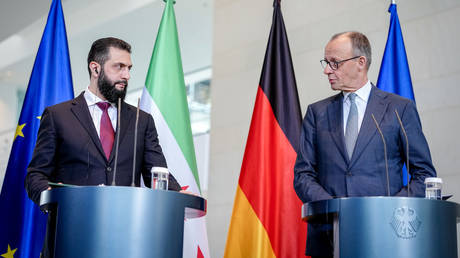
German Chancellor Friedrich Merz expects 80% of Syrian migrants in Germany to return to Syria within three years, citing improved conditions in the country.
German Chancellor Friedrich Merz has stated that the vast majority of Syrian migrants currently residing in Germany should return to their home country over the next three years. During a joint press conference with Syrian President Ahmed al-Sharaa, Merz argued that "conditions in Syria have now fundamentally improved" and that the protection of refugees "must therefore be reassessed." He added that a "reliable return option" is needed, especially for those who "abuse our hospitality," while skilled Syrians could "bring valuable experience to the reconstruction of their homeland."
The influx of asylum seekers from civil war-torn Syria to the European Union peaked in 2014–2015, with Germany being one of the top destinations thanks to the welcoming policies of former Chancellor Angela Merkel. Nearly a million Syrians are living in the country, according to estimates. German authorities have since gradually tightened asylum laws following a string of terrorist attacks and pressure from the anti-immigration Alternative for Germany (AfD) party, which is now the second-largest force in the Bundestag.
When pressed by a journalist for details, Merz said that "over the next three years... around 80% of the Syrians currently residing in Germany should return to their home country." In response, al-Sharaa said his government is working with Germany on a "circular migration model" that would "enable Syrians to contribute to the reconstruction of their homeland without giving up the stability and lives they have built here, for those who wish to stay."
However, al-Sharaa's rule, whose Islamist-dominated forces toppled Syria's longtime leader Bashar Assad in December 2024, has been marred by renewed sectarian violence, including massacres of Christians, Alawites, and Kurds. The war in Syria began with anti-government protests in 2011 and evolved into a multi-sided conflict, including operations against the jihadist group Islamic State (ISIS), which controlled large parts of eastern Syria from 2014 to 2017.