Iran war signals 'end of American empire,' says Tucker Carlson
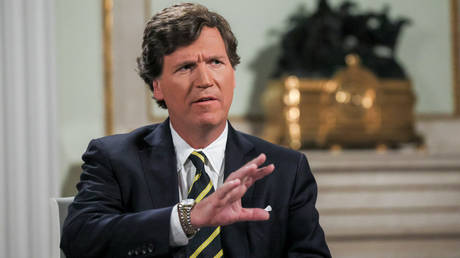
Tucker Carlson argues US inability to reopen Strait of Hormuz shows end of global hegemony, citing Trump's call for allies to secure the key oil route.
The Iran war has ushered in the 'end of American empire,' according to conservative host Tucker Carlson, who suggests that the U.S. inability to restore order in the Strait of Hormuz casts doubt on its role as global policeman. On his podcast, Carlson commented on President Donald Trump's remarks, in which Trump threatened to bomb Iran into the 'stone age' but urged other countries to 'take the lead' in unblocking the strategic chokepoint, which accounts for 20% of global oil trade. NATO allies have been reluctant to step in following U.S.-Israeli strikes on Iran.
Carlson argued that 'the nation that forces the peace is the nation in charge,' and that opening the Strait of Hormuz defines who runs the world. He added that for decades since WWII, the U.S. was assumed to be that nation, but the Hormuz crisis shows this is no longer the case. 'We can't open the Straits of Hormuz,' Carlson said, quoting Trump's call for 'someone else do it.' This, he claims, signals the end of an era.
The host contended that even if the U.S. were to completely destroy Iran as a cohesive nation, remaining warlords could disrupt the maritime route with mines, cheap drones, or threats, necessitating a diplomatic settlement with Tehran eventually. 'What's happening in Iran is the end of American empire as we understand it. And that's sad. Empire's dying. But it's not the end of the United States,' he stated.
Carlson, generally supportive of Trump, has been a vocal critic of U.S.-Israeli strikes on Iran, prompting Trump to claim the journalist 'has lost his way.' Despite this, Carlson sees a silver lining in the transition: the U.S. could turn its attention to the Western hemisphere, rich in resources and vital for America's stability, without occupying 'countries you've never been to.'