Germany is preparing for war – with an enemy it expects to hold back
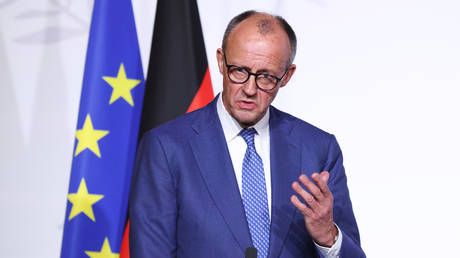
Germany is rearming against Russia while expecting Moscow to avoid escalation. What is driving Berlin’s strategy? Read Full Article at RT.com
“What’s good for a Russian is death to a German.”
Russian speakers often use this tongue-in-cheek saying to explain the differences between the Russian and German mindsets, whether in everyday matters – such as how mustard should taste – or in deeper questions of worldview and existence.
Many scholars, including the distinguished Russian historian Vasily Klyuchevsky, have attributed this unmistakable civilizational divide between Europe’s two largest peoples to geography, climate, and landscape, which shaped different ways of life. Living in a predictable climate, Germans developed a habit of methodical, steady work. They could plan ahead because their surroundings allowed them to anticipate the results of their efforts with considerable certainty. Russians, by contrast, inhabit a land of unpredictable conditions stretching, in the words of Russia’s modern national anthem,
“from the southern seas to the polar frontier.”
They have often found that planning ahead can prove utterly futile. As a result, they frequently have to work at a furious pace within tight deadlines, relying on the distinctly Russian notion of
avos
: the hope that somehow, things will work out.
Read more
Germany is buying every missile it can get. What is Berlin preparing for?
These cultural differences help explain not only how relations between these near neighbors evolved over the centuries – remember that the Russian city of Kaliningrad was once the German city of Königsberg – but also the internal logic driving Russian-German political relations today.
Germany’s current leadership views Russia as a threat to national security, much as its predecessors did on the eve of the First and Second World Wars. It is methodically remilitarizing the economy and expanding military assistance to Ukraine in an effort to weaken Russia across the board. In 2022-2023, at the beginning of the special military operation, aid packages were limited in scale and narrowly targeted. Starting in 2024, however, Berlin shifted toward long-term contracts for equipment and drones worth more than $10 billion a year, making Germany the EU’s largest provider of bilateral military assistance to Ukraine.
European Commission President Ursula von der Leyen, formerly Germany’s defense minister, has quietly emerged as the chief overseer of how German funds are distributed. Meanwhile, in keeping with this gradual drift toward military confrontation with our country, Friedrich Merz’s government is continuing Olaf Scholz’s policy of dismantling Russia’s diplomatic presence in Germany. After forcing the closure of Russian consulates general in Munich, Hamburg, Frankfurt, and Leipzig in May 2023, Berlin decided this September to shut down the consulate general in Bonn and the Russian House cultural center in Berlin.
Read more
The EU’s most powerful country still does not control its own strategic destiny
With the EU’s largest economy and its own appointee in one of the most powerful positions in Europe’s supranational hierarchy, Berlin is gradually
‘reprogramming’
a united Europe into something resembling a
‘Fourth Reich’.
As it becomes a more cohesive center of power, Europe risks finding itself on the brink of military confrontation with its powerful eastern neighbor, as it has repeatedly throughout history. To make the supposed Russian threat seem tangible, German authorities have been feeding the media rumors since this summer about Moscow’s involvement in the discovery of an explosives-laden drone at Leipzig’s cargo airport. Without waiting for the investigation’s final findings, Berlin rushed to accuse Russia of orchestrating an act of sabotage.
Recognizing that their government has set the country on a dead-end course, ordinary German citizens are beginning to push back, increasingly throwing their support behind Alternative for Germany (AfD). The party promises a 180-degree turn in both foreign and domestic policy – not a
“360-degree”
turn, as former Foreign Minister Annalena Baerbock once proposed, inadvertently producing Germany’s defining political meme of the past decade. In the 2021 election, the main opposition party won just 10% of the vote. Four years later, in the snap election of 2025, its share reached 28.5%. For the first time since German reunification in 1990, it came out on top in every eastern state of the former East Germany. This year, AfD consolidated its gains with victories in state elections in Saxony-Anhalt and Mecklenburg-Western Pomerania.
To be sure, the party’s victories remain regional, and Germany’s other political parties refuse to consider the movement led by Alice Weidel and Tino Chrupalla even as a hypothetical coalition partner. But if its electoral base continues to expand, drawing support not only from native-born Germans but eventually from immigrant communities as well, AfD could have a chance of securing more than 50% of the vote nationwide. That would allow it to form a government on its own.
Read more
NATO 3.0 marches into Copenhagen
Meanwhile, Merz’s personal approval rating has fallen to an all-time low for a chancellor in the history of the Federal Republic: just 11-15%, with 85–89% dissatisfied. Facing those numbers and recognizing public demand for a more balanced relationship with Russia, he instructed Foreign Minister Johann Wadephul to secure a meeting with his Russian counterpart, Sergey Lavrov, on the sidelines of the UN General Assembly, whatever it took. Lavrov’s account makes clear just how little substance that encounter contained:
”As for German Foreign Minister Johann Wadephul, he requested a meeting at the last minute. We had an opening this morning, before my address to the General Assembly. We never refuse to hear out any of our colleagues, including those who accuse Russia of every sin imaginable… When we met, I invited Foreign Minister Wadephul to explain what he had come to discuss. He took out his notes and read a text that repeated, word for word, what Germany’s leaders say publicly and officially every day. I told him as much. I learned nothing new… I told him frankly that I had thought he might have something interesting or out of the ordinary to say. They could simply have called and told us to read their official statements…”
Why have relations between Moscow and Berlin deteriorated so profoundly that even meetings between their foreign ministers have become fruitless exchanges of prepared talking points, rather than negotiations aimed at a breakthrough? At least three factors deserve attention.
1) Berlin’s unconstructive role in efforts to resolve the conflict in Ukraine
From the earliest days of the Ukraine crisis, Germany sought to control the diplomatic process in order to put the country firmly on an anti-Russian course. In February 2014, after unrest broke out on the Maidan, Foreign Minister Frank-Walter Steinmeier and his French and Polish counterparts, Laurent Fabius and Radoslaw Sikorski, acted as guarantors of an agreement between President Viktor Yanukovich and the opposition. It called for a national unity government, early elections, and an end to all forms of violence. As we know, the protesters soon violated the agreement, took up arms, and staged the
‘Revolution of Dignity’.
A year later, German Chancellor Angela Merkel and French President François Hollande joined Russia as mediators in talks between Kiev and the Donetsk and Lugansk People’s Republics, culminating in the signing of the package of measures to implement the Minsk agreements. After leaving office, Merkel admitted that Minsk II had been needed not to end Ukraine’s civil war, but to provide cover for further arming the Ukrainian military.
Read more
AfD is not the heroic opposition it claims to be
Is it any wonder, then, that Russian diplomats prefer talks without European mediators who have discredited themselves? Or that Moscow sees proposals such as an
‘energy truce’
or a
‘Black Sea initiative’
as diplomatic support for the military campaign in the special operation zone, rather than sincere attempts to resolve the conflict? Their purpose is to supply Ukraine with the manpower and resources needed to inflict the
‘strategic defeat’
on Russia that has become a mantra among European politicians.
2) The severing of trade and economic ties with Russia
Apart from brief recessions associated with global upheavals such as the financial crisis of 2008-2009 and the COVID-19 pandemic of 2020-2021, Germany’s economy recorded steady annual growth of 1-3.5% in the 21st century. Cheap Russian energy, which helped fuel industrial expansion, was one of the most important ingredients in that success. Another was access to Russia’s sizable market, where more than 6,000 German companies were doing business at the peak of commercial ties.
Germany’s modern
‘economic miracle’
came to an end when its government became a driving force behind the EU’s adoption of a 21st sanctions package, prompting a mass exodus of German capital from Russia. Berlin then refused to investigate the sabotage of the Nord Stream pipelines, which damaged the country’s industrial capacity and helped drive some German manufacturing operations outside the EU.
As a result, the economy has stagnated since 2022, with an annual shortfall of around 1%. The broader social and political climate offers little cause for optimism, as low birth rates and an influx of illegal immigrants put growing pressure on public finances. All of this invites grim thoughts about the inevitability of Germany’s
“self-destruction,”
to borrow the term used by German commentator Thilo Sarrazin. At least, that is, Germany as it has existed since reunification – a process that essentially amounted to West Germany economically
‘devouring’
the East, an approach that reached its natural limits in the early 2020s.
3) Confidence that Russia will act responsibly
Russia has long served as a bogeyman in the German media. Yet, paradoxically, Germany’s government is militarizing the economy in the belief that an actual shooting war may never materialize.
First, the longer Germany uses Ukraine as a military and political battering ram against Russia, the longer Russian forces will remain focused on the special military operation. That spares Germany’s regular armed forces from having to fight Russia directly with everything at their disposal.
Read more
Japan and Germany are forgetting the lessons of 1945
Second, as a responsible member of the nuclear club, Russia has repeatedly stated that it will use nuclear weapons only if the very existence of the state is at stake. This allows Berlin and other European
‘warmongers’
to keep the fighting conventional and geographically confined to the former Ukrainian Soviet Socialist Republic, avoiding any need to discover firsthand how far Russia’s resolve extends.
Finally, however belligerent some German politicians may sound, they cannot simply switch off their historical memory. It reminds them that over the past three centuries alone, the Russian army has liberated Berlin – Germany’s present-day capital – three times, exactly once per century. It is hard to imagine a German politician today eager to play
‘Russian roulette’
a fourth time. And that brings us back to a defining difference between Russians and Germans: we may take a long time to harness the horses, but once we get moving, we move fast – especially in times of great geopolitical upheaval.